The Correct Order to Start an LLC in the USA (Most People Get This Wrong)
Most people start an LLC in the wrong order and create banking, tax, or compliance problems later. Learn the correct step-by-step sequence for forming an LLC in the USA while avoiding costly mistakes and delays.
12/28/202518 min read
The Correct Order to Start an LLC in the USA (Most People Get This Wrong)
The moment you decide to start an LLC, something dangerous happens.
Not on paper.
Not in a government office.
But inside your head.
You start imagining the business already exists.
You picture the logo.
The website.
The Stripe account.
The clients.
The income.
And because of that mental shortcut, you rush.
You Google:
“How to start an LLC.”
You click the first checklist.
You file something.
You open something.
You sign something.
And that’s how tens of thousands of Americans end up with:
Frozen bank accounts
Rejected EINs
IRS letters they don’t understand
Stripe accounts shut down
Lawsuits they didn’t see coming
Or LLCs that exist on paper but are legally useless
All because they did things in the wrong order.
Forming an LLC is not just about what you do.
It is about the sequence.
In the U.S. legal system, order creates legality.
The same steps in the wrong sequence can destroy your protection, your tax status, and your ability to operate.
This guide shows you the exact, legally correct order to start an LLC in the United States — the one banks, the IRS, Stripe, PayPal, courts, and tax agencies all recognize.
No myths.
No TikTok shortcuts.
No influencer nonsense.
Just the real system that actually works.
Why Order Matters More Than the LLC Itself
Most people believe this lie:
“Once I file an LLC, I’m protected.”
That is not how U.S. law works.
An LLC is not a magic shield.
It is a legal structure that only exists if you assemble it correctly.
Imagine building a house.
You don’t pour the roof first.
You don’t install plumbing before walls.
You don’t move furniture into a hole in the ground.
But that’s exactly how people treat LLCs.
They open Stripe first.
They take payments first.
They sign contracts first.
They advertise first.
Then they rush to “add an LLC later.”
And then when something goes wrong — lawsuit, refund dispute, IRS audit — the court looks at the timeline.
And the timeline decides everything.
If you took money before the LLC existed, you were a sole proprietor.
If you signed contracts before the EIN existed, you personally signed them.
If you opened a bank account before the Operating Agreement, you pierced your own veil.
The order is what decides:
Who is legally liable
Who owes the tax
Who owns the money
Who gets sued
Who gets protected
Now let’s walk through the correct order, step by step, the way lawyers, banks, and the IRS actually expect it to be done.
Step 1: Decide the State Before You Do Anything Else
This is where most people already screw up.
They ask:
“Where should I form my LLC?”
After they’ve already started doing business.
That is backwards.
Your LLC state determines:
Which court has power over you
Which tax agency controls you
Which laws apply to your company
Which fees you pay every year
Whether your LLC is even valid
If you live and operate in California, Texas, Florida, New York, or Illinois, forming in Wyoming or Delaware does not magically save you.
If you run the business from your home, laptop, phone, or U.S. address, your “nexus” is where you are.
That means:
If you live in California and form in Wyoming, California will force you to register as a foreign LLC and charge you the $800 franchise tax anyway.
So the real rule is simple:
You form in the state where you actually operate.
Only two categories of people can legitimately choose a different state:
People with no U.S. presence (international founders)
People with large venture-backed structures
Everyone else should form where they live.
Because the state determines everything that comes after.
Step 2: Choose the LLC Name (Before You File Anything)
This sounds trivial.
It is not.
Your LLC name controls:
Your Articles of Organization
Your EIN
Your bank account
Your Stripe account
Your contracts
Your legal identity
If you change it later, you must update every single one of those systems.
So you do this now.
You must check:
State availability
Trademark conflicts
Domain availability
Banking acceptance
If your name is rejected by your state, your filing fails.
If it conflicts with a trademark, you risk lawsuits.
If banks don’t like it, they block accounts.
This is why professionals always lock the name first.
Step 3: Appoint a Registered Agent (This Is Not Optional)
Your Registered Agent is the legal mailbox of your LLC.
This is where:
Lawsuits are delivered
State notices are sent
Compliance letters arrive
If you miss one of these, your LLC can be administratively dissolved without warning.
If that happens, your liability protection vanishes.
This must be in place before you file.
Step 4: File Articles of Organization (This Creates the LLC)
This is the moment your LLC is born.
Not when you open a bank account.
Not when you make a website.
Not when you start selling.
When the state accepts your Articles of Organization, your LLC exists.
This document includes:
Your LLC name
Your Registered Agent
Your address
Your management structure
This filing is what courts, banks, and the IRS recognize as the birth certificate of your company.
Everything else depends on this date.
Step 5: Get an EIN From the IRS (Do NOT Skip This)
Your EIN is your LLC’s Social Security number.
Without it:
You cannot open a business bank account
You cannot use Stripe
You cannot pay taxes
You cannot hire
You cannot file returns
The IRS uses the EIN to track your LLC.
If you apply before your LLC exists, the EIN is invalid.
If you apply with the wrong name or state, it gets flagged.
The EIN must match your Articles exactly.
This is why it comes after formation, not before.
Step 6: Create an Operating Agreement (Even If You’re Solo)
This is where people destroy their own protection.
They think:
“I’m a single-member LLC. I don’t need one.”
Wrong.
Your Operating Agreement proves:
That your LLC is separate from you
How money is handled
Who owns what
How decisions are made
Without this document, courts assume your LLC is just you with a different name.
That is how people lose lawsuits and personal assets.
This must exist before you touch money.
Step 7: Open the Business Bank Account (Now — Not Earlier)
Only now do you open the bank account.
Why?
Because now you have:
An LLC
An EIN
An Operating Agreement
This creates separation.
All income goes into this account.
All expenses come out of it.
No mixing.
No PayPal into your personal account.
No Stripe to your own name.
This separation is what keeps you protected.
Step 8: Connect Stripe, PayPal, and Payment Systems
Payment processors verify:
Your EIN
Your business name
Your bank account
Your legal existence
If anything doesn’t match, they freeze you.
This is why this comes now.
Not before.
Step 9: Start Doing Business
Only now are you legally operating as an LLC.
Before this moment, you were either:
Not a business
Or a sole proprietor
Now you are protected.
Now your contracts bind the LLC.
Now your income belongs to the company.
Now your liability is limited.
What Happens When You Do This Out of Order
Let’s look at what happens when people rush.
Example 1: Stripe Before LLC
You launch a website.
You collect $5,000.
Then you form the LLC.
Legally, that $5,000 is your personal income.
You owe self-employment tax.
The LLC doesn’t own it.
Example 2: Bank Account Before Operating Agreement
You open an account.
You take money.
You get sued.
The lawyer asks for your Operating Agreement.
You don’t have one.
The judge says:
“This LLC is not real.”
And you lose protection.
Example 3: EIN Before Formation
Your EIN doesn’t match.
The IRS flags you.
Banks reject you.
Payments get frozen.
And now you’re trapped in bureaucracy hell.
The Real Reason People Get This Wrong
Because the internet teaches you to optimize for speed.
But the legal system only cares about sequence.
You cannot hack sequence.
You cannot skip it.
You cannot fix it later.
Once you take money in the wrong order, the damage is done.
And that’s why so many online businesses collapse when they scale.
They were built on the wrong legal foundation.
The Moment This Becomes Dangerous
Everything feels fine… until:
A customer demands a refund
A chargeback hits
A tax letter arrives
A competitor threatens
A contractor sues
Stripe asks for verification
That’s when your timeline gets examined.
And the order decides who wins.
This Is Why Professionals Use a System
Real founders do not rely on Google.
They follow a legal sequence.
That sequence is what you just learned.
But knowing the order is not enough.
You must execute it correctly — with the right forms, the right language, the right filings, the right compliance.
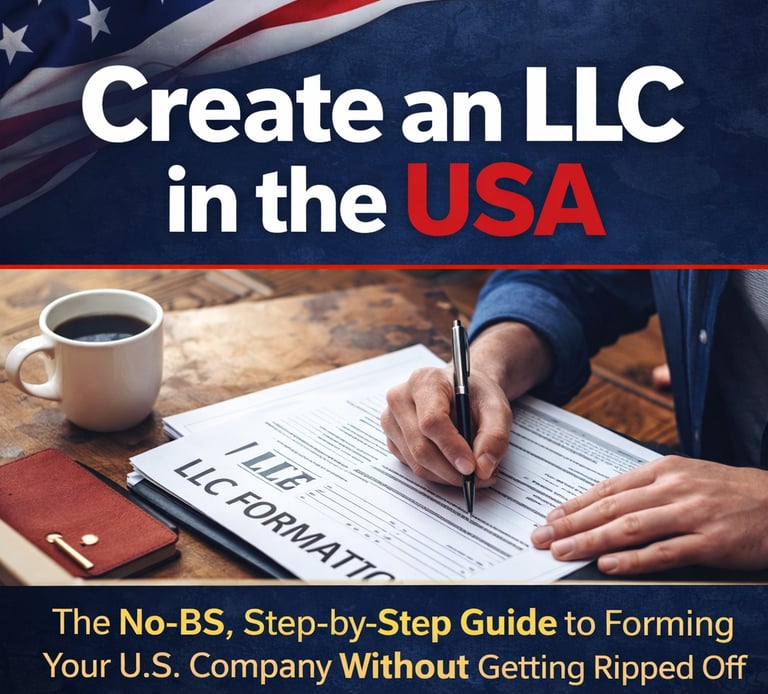
That is exactly what the Create an LLC in the USA eBook was built for.
It gives you:
The exact forms
The correct wording
The state-by-state rules
The EIN walkthrough
The Operating Agreement templates
The banking setup
The Stripe and PayPal setup
The tax election timing
So you don’t guess.
You don’t risk.
You don’t lose protection.
You build it right from day one.
👉 Get the Create an LLC in the USA eBook now and follow the exact legal blueprint professionals use to build real, protected U.S. businesses.
Because in the United States, it’s not what you do.
It’s the order you do it in.
continue
…Because in the United States, the order you do things in becomes the legal truth — and once that truth is written into records, bank logs, IRS timelines, and payment processor databases, it can never be rewritten.
And this is where things get dangerous for people building online businesses, digital products, consulting services, Amazon stores, SaaS platforms, dropshipping brands, content sites, or micro-niche websites like the ones you’re building.
You don’t just have one timeline.
You have five:
The state’s timeline (when the LLC was created)
The IRS timeline (when the EIN was issued)
The bank’s timeline (when accounts were opened)
The payment processor’s timeline (when money first came in)
The public timeline (when your site, ads, or platform went live)
If those five timelines don’t line up, you don’t have an LLC.
You have a paper shell.
And paper shells do not survive audits, lawsuits, or frozen accounts.
Let’s go deeper into how this actually plays out in the real world.
The “Phantom LLC” Problem
A phantom LLC is what happens when people think they have a company… but legally they don’t.
It looks real:
You have a logo
A domain
A Stripe account
A bank account
Even a filing receipt
But one element is out of order — and that makes the entire structure collapsible.
Here’s a real scenario that happens every day:
You launch a site.
You connect Stripe.
You sell an ebook.
You make $12,430 in three months.
Then you form an LLC and transfer the money into a new bank account.
You think:
“Now it’s all in the LLC. I’m safe.”
Legally, that money never belonged to the LLC.
It belonged to you at the moment of sale.
When Stripe processed that card, the merchant of record was you.
When the customer clicked Buy, they paid you.
When PayPal received the funds, it credited you.
Moving money later does not change ownership.
So when the IRS audits you, they don’t care where the money is now.
They care who owned it when it was earned.
And that single sequencing mistake can turn a $12,000 year into:
Self-employment tax
Penalties
Late filing fees
Reclassification of income
Loss of LLC tax benefits
This is why order is not cosmetic.
It is everything.
Why Banks and Stripe Are the First to Catch You
You don’t need a lawsuit to get destroyed.
Banks and payment processors enforce legal order automatically.
Here’s what happens behind the scenes:
When you open a Stripe account, Stripe creates a compliance profile.
It records:
Legal entity name
Formation date
EIN
Business address
Owner identity
Bank account
First transaction date
Stripe runs this against:
The IRS
State business databases
OFAC
AML systems
Fraud detection systems
If anything doesn’t match, you get flagged.
If your first sale happened before your LLC existed, Stripe sees:
“This entity took money before it legally existed.”
That is considered high-risk behavior.
So what do they do?
They freeze.
They ask for documents.
They hold funds.
They sometimes shut you down.
And once a processor flags you, that mark follows you.
PayPal. Square. Shopify Payments. They all share data.
One sequencing mistake can poison your entire payment future.
The IRS Uses Sequence to Decide Your Tax Status
This is the part almost nobody understands.
The IRS does not care what you call yourself.
They care about when things happened.
If you formed an LLC on March 10 but earned money on February 5, you were not an LLC on February 5.
You were a sole proprietor.
That means:
Self-employment tax
No corporate deductions
No S-corp election
No QBI benefits
No liability shield
You cannot retroactively “assign” income to an LLC.
That is illegal.
The IRS calls it assignment of income, and it triggers audits.
So the correct order protects not just your assets — it protects your taxes.
Courts Look at Timeline, Not Intent
This is where it becomes life-changing.
You might think:
“But I meant to run it as an LLC.”
Courts don’t care what you meant.
They care what you did.
If a lawsuit happens, the judge and attorneys will pull:
Your bank statements
Your Stripe logs
Your PayPal reports
Your state filings
Your EIN issue date
Your contracts
Your website launch date
They will build a timeline.
And then they will ask:
“Was this business actually an LLC when the harm occurred?”
If the answer is no, your LLC disappears.
You become personally liable.
Your house.
Your savings.
Your future income.
That’s what’s on the line.
The Hidden Step Nobody Tells You About: Pre-LLC Activity
People always ask:
“Can I start building my business before forming an LLC?”
Yes — but only in a very specific way.
You can:
Research
Write content
Design logos
Build websites
Draft products
Prepare marketing
But you cannot:
Take payments
Sign contracts
Accept clients
Run ads
Deliver services
Sell products
Those actions create legal transactions.
And legal transactions must belong to an entity.
If that entity doesn’t exist yet, they belong to you.
So the safe pre-LLC phase is preparation only.
The moment money enters the system, the clock starts.
The Clean Timeline That Protects You
A perfect LLC timeline looks like this:
Day 1–30:
You plan, build, write, prepare.
Day 31:
You file Articles of Organization.
Day 32:
Your LLC is approved.
Day 33:
You get your EIN.
Day 34:
You sign your Operating Agreement.
Day 35:
You open your business bank account.
Day 36:
You connect Stripe and PayPal.
Day 37:
You launch.
That is what banks, courts, and the IRS consider a “clean” company.
Anything else is a risk.
Why Online Businesses Are More Vulnerable
If you run a physical store, the sequence is obvious.
But online businesses blur the line.
You can:
Launch a site in minutes
Take payments instantly
Use personal accounts
Hide mistakes for months
Until the volume grows.
Until Stripe reviews you.
Until PayPal flags you.
Until you hit $20,000 in sales.
That’s when the system wakes up.
And if your foundation is wrong, everything gets pulled apart.
The Lie That Destroys Founders
The biggest lie on the internet is:
“You can just fix it later.”
No.
You can’t.
Once money touches the wrong entity, it is forever attached to that entity.
You can’t retroactively rewrite legal history.
This is why serious founders treat their LLC like a surgical procedure.
One clean cut.
One correct sequence.
One protected structure.
This Is Why You Need a Blueprint, Not a Blog Post
You don’t just need to know the order.
You need:
The right forms
The right state language
The right EIN method
The right Operating Agreement clauses
The right bank setup
The right payment processor structure
The right tax elections
The right compliance calendar
That is what the Create an LLC in the USA eBook gives you.
It is not theory.
It is the exact legal blueprint used to create real U.S. companies that survive audits, lawsuits, Stripe reviews, and IRS scrutiny.
You don’t get protection by hoping.
You get it by building correctly.
👉 Get the Create an LLC in the USA eBook now and follow the exact, legally correct sequence to build a real, protected U.S. business — before you make a single dollar.
Because once the money hits, the timeline is locked forever.
continue
…forever — and once that timeline is locked, it becomes the legal reality that every institution will use against you or for you.
Now we are going to go even deeper, because there is one layer of this process that almost nobody on the internet talks about, yet it is the layer that separates hobby businesses from real, bankable, scalable U.S. companies.
It’s called entity hygiene.
And it is entirely controlled by order.
What “Entity Hygiene” Actually Means
Entity hygiene is the invisible legal cleanliness of your LLC.
It’s not whether you have an LLC.
It’s whether your LLC is treated as real by:
Banks
Payment processors
The IRS
Courts
Investors
Partners
Two people can both have LLCs.
One gets loans, Stripe never freezes them, taxes are simple, lawsuits bounce off.
The other gets shut down, audited, denied, and personally exposed.
The difference is not luck.
It is sequence.
How the Government Knows You Did It Wrong
The U.S. government has something called cross-system verification.
When you:
File an LLC
Apply for an EIN
Open a bank account
Process a payment
File a tax return
Those systems talk to each other.
They match:
Dates
Names
Addresses
Owners
Activity
If your Stripe shows income before your EIN date, that’s a mismatch.
If your EIN predates your LLC, that’s a mismatch.
If your bank account opened before your Operating Agreement, that’s a mismatch.
Mismatches are what trigger:
Compliance reviews
Freezes
Audits
Investigations
You don’t get flagged for being small.
You get flagged for being out of sequence.
Why So Many Internet Gurus Accidentally Commit Tax Fraud
Most online courses tell people to:
Start selling
See if it works
Then “add an LLC”
That advice is legally toxic.
It encourages people to earn money as individuals and then pretend it belonged to a company.
That is assignment of income.
The IRS treats that as fraud.
It doesn’t matter if you didn’t know.
Ignorance is not a defense.
The Difference Between a Hobby and a Business
This is not philosophical.
The IRS has an entire legal framework for this.
If you start selling before forming an entity, you are classified as a sole proprietor.
Even if you later create an LLC, the early activity is still personal.
That means:
You cannot deduct business startup costs correctly
You cannot elect S-Corp for that period
You cannot shield liability
You cannot move losses or profits into the LLC
Your timeline becomes split.
And split timelines create accounting nightmares.
Why “I’ll Just Transfer the Money” Doesn’t Work
People think money is what matters.
Legally, it isn’t.
Ownership is what matters.
Who owned the right to receive the money at the moment the sale happened?
That’s what decides tax, liability, and control.
If your website had your name, your Stripe had your name, and your EIN didn’t exist yet, the sale belonged to you.
Moving money later is irrelevant.
The sale is already recorded.
The One Exception: Pre-Incorporation Agreements
Large companies sometimes sign contracts “on behalf of a company to be formed.”
But this is a legal instrument.
It requires specific language.
It requires ratification.
It requires corporate adoption.
You cannot accidentally do this.
If you don’t know what it is, you didn’t do it.
Why This Is Critical for Digital Products and eBooks
This matters even more for online products like:
eBooks
Courses
SaaS
Templates
Subscriptions
Consulting
Micro-niche websites
Because:
Payments are instant
Customers are anonymous
Processors are automated
Volume grows fast
You can make thousands of dollars before you even realize something is wrong.
And then it’s too late.
The “Single-Member LLC” Trap
People think:
“I’m alone. It doesn’t matter.”
It matters more.
Single-member LLCs are scrutinized harder because:
They look like personal shells
They are easier to pierce
They require stricter separation
Your Operating Agreement, bank accounts, EIN, and timeline are what keep you protected.
If those are sloppy, courts ignore your LLC.
The Dirty LLC
A “dirty” LLC is one with:
Mixed money
Wrong dates
Missing documents
Personal use
Out-of-sequence activity
It might exist in a state database.
But in court, it collapses.
And when it collapses, everything comes back to you.
The Clean LLC
A clean LLC has:
A clear formation date
An EIN issued after formation
An Operating Agreement before money
A bank account opened correctly
Payment processors attached to the entity
All income flowing into the LLC
All expenses paid by the LLC
That is what lawyers call corporate formalities.
And that is what keeps you safe.
This Is Why You Can’t “Wing It”
LLC formation is not creative.
It is procedural.
It must be done in the correct order with the correct documentation.
The Create an LLC in the USA eBook gives you that sequence step-by-step:
What to do
When to do it
How to do it
What not to do
And how to avoid the traps that kill protection
You don’t need to be a lawyer.
You need a blueprint.
👉 Get the Create an LLC in the USA eBook now and build your company the way banks, courts, and the IRS actually recognize — not the way influencers guess.
Because once your business starts making money, the order you followed becomes the law that governs your future.
continue
…your future — and now we are going to expose the most dangerous mistake of all: thinking that once the LLC exists, the past doesn’t matter.
It does.
It matters more than anything else.
Because in U.S. law, your company is not judged by what it is today.
It is judged by what it was at the exact moment a transaction happened.
And that single idea is what separates people who sleep at night from people who get IRS letters, frozen Stripe balances, and lawsuits they never saw coming.
The “Time Machine” Illusion
People think forming an LLC is like a time machine.
They believe:
“Once my LLC exists, it covers everything I’ve done.”
That is false.
An LLC is not retroactive.
It does not go back in time.
It does not absorb past activity.
It does not shield yesterday’s mistakes.
If you made sales before your LLC was born, those sales are personal forever.
Even if you move the money.
Even if you change the Stripe name.
Even if you file taxes differently.
The timeline is permanent.
Why This Destroys Online Entrepreneurs
Let’s say you built a niche site.
You did exactly what many people do:
You bought a domain
You wrote content
You connected Stripe
You sold an ebook
You made $2,000
Then you thought:
“This works. I should form an LLC.”
So you did.
Now you believe:
“Everything is under the LLC.”
It isn’t.
That $2,000 is not.
And if a customer from that period sues you, they are not suing your LLC.
They are suing you.
If Stripe gets a chargeback from that period, they freeze you.
If the IRS audits that income, they audit you.
The LLC didn’t exist yet.
So it can’t protect you.
The IRS Uses “Date of First Business Activity”
The IRS tracks when you first became “engaged in a trade or business.”
This is not when you filed.
This is when you:
Took money
Provided services
Delivered products
That date is what defines your tax year, your filing requirements, and your classification.
If that date is before your LLC, you were a sole proprietor.
That classification sticks.
Why Even One Dollar Matters
People think:
“It was just one sale.”
Doesn’t matter.
One dollar creates a legal transaction.
One transaction creates a tax record.
A liability record.
A consumer protection record.
You can’t erase it.
The Chargeback Time Bomb
Stripe and PayPal allow customers to dispute charges months later.
If someone disputes a charge from before your LLC existed, guess what happens?
The dispute is against you.
Even if your account is now under the LLC.
The original transaction belongs to the original entity.
That’s how processors work.
This Is Why Professionals Delay Launch
Serious founders do something that feels slow but is actually fast.
They prepare everything.
They wait.
They form the LLC.
They get the EIN.
They open the bank.
They connect payments.
Then they launch.
Because they know the first dollar sets the legal identity of the business.
You only get one first dollar.
The Moment of Birth Matters
In law, entities are born like people.
Before birth, they do not exist.
After birth, they do.
Everything that happened before belongs to someone else.
That is the concept.
Why This Is Even More Important If You Scale
When you make $100, nobody cares.
When you make $100,000, everyone cares.
Banks care.
Tax agencies care.
Payment processors care.
Investors care.
They all look backward.
They all reconstruct your history.
If it’s clean, you pass.
If it’s messy, you get blocked.
The Two Types of Founders
There are only two types:
Those who build correctly from the first dollar
Those who try to clean it up later
The second group pays more.
Loses more.
Stresses more.
And often loses everything.
This Is Why the Blueprint Exists
The Create an LLC in the USA eBook was written for one reason:
To give you the exact legal sequence so that:
Your first dollar is clean
Your first sale is protected
Your first customer belongs to the LLC
Your first tax filing is correct
Your Stripe account is safe
Your liability is limited
You don’t guess.
You don’t risk.
You follow the blueprint.
👉 Get the Create an LLC in the USA eBook now and make sure your business is born the right way — because in U.S. law, the day you start making money is the day your legal fate is sealed.
And once that day passes, there is no going back.
continue
…back — and now we are going to dismantle the final illusion that keeps people stuck in legal danger for years without realizing it:
“If something is wrong, my accountant will fix it.”
They can’t.
Because accountants don’t control entity order.
They only report what already happened.
And if what already happened was out of sequence, the damage is permanent.
Why You Cannot “Fix” a Bad LLC Later
When you file taxes, you are not creating reality.
You are reporting it.
The IRS, Stripe, banks, and courts already have their own records.
They already know:
When you first received money
When your EIN was issued
When your LLC was formed
When your bank account opened
When your Stripe account went live
Your tax return is just a summary.
If it conflicts with those records, you get audited.
You can’t override them.
The “Backdate” Myth
Some people think:
“I’ll just backdate the LLC.”
That is a crime.
States record the exact time your Articles were filed.
The IRS records the EIN issue date.
Banks log account creation.
Stripe logs first transaction.
You cannot change any of that.
Trying to fake it is fraud.
Why S-Corp Elections Fail When the Order Is Wrong
Many people want to elect S-Corp status to save taxes.
But S-Corp elections depend on:
When the LLC was formed
When the EIN was issued
When the election was filed
When income was earned
If income was earned before the entity existed, you cannot retroactively move it into the S-Corp.
That income is forever subject to self-employment tax.
People lose tens of thousands of dollars this way.
Why Venture Capital and Banks Check This
If you ever want:
A loan
A line of credit
An investor
A buyer
A partner
They will do due diligence.
They will examine:
Formation documents
First revenue
Bank statements
Payment processor records
If your company earned money before it legally existed, they call it defective formation.
Deals die because of this.
The Internet Makes This Worse
Because everything is easy.
Domains are instant.
Stripe is instant.
PayPal is instant.
Sales are instant.
But law is not.
Law moves on recorded sequence.
That mismatch is what traps people.
The Correct Mindset
The correct mindset is:
“I am not starting a business when I launch.
I am starting it when I form the entity.”
Everything before that is preparation.
Everything after that is protected.
Why This Is Especially Important for Digital Empires
If you are building dozens of sites, brands, funnels, ebooks, subscriptions, or SaaS products, this matters even more.
Because one mistake multiplied by 50 properties is catastrophic.
You don’t want 50 dirty timelines.
You want one clean structure that everything plugs into.
How Professionals Do It
Professionals don’t rush.
They do this:
Form the holding LLC
Get the EIN
Set up the bank
Set up Stripe
Then launch as many properties as they want
Every dollar flows into the same legal entity.
Every property is protected.
Every sale is clean.
This Is What the Blueprint Shows You
The Create an LLC in the USA eBook walks you through:
The exact formation order
The IRS EIN process
The Operating Agreement structure
The banking setup
The payment processor linking
The tax elections
The compliance calendar
So that you don’t accidentally create a fake company that collapses when it matters.
👉 Get the Create an LLC in the USA eBook now and build your business on a foundation that survives banks, Stripe, taxes, and lawsuits — not just Google searches.
Because the U.S. legal system does not forgive mistakes.
It only records them.
👉 The 60+ page No-BS LLC Guide walks you through the entire process in the correct order, without overpaying or guessing.https://createllcusa.com/create-an-llc-in-the-usa-ebook
Help
Questions? Reach out anytime, we're here.
infoebookusa@aol.com
© 2026. All rights reserved.